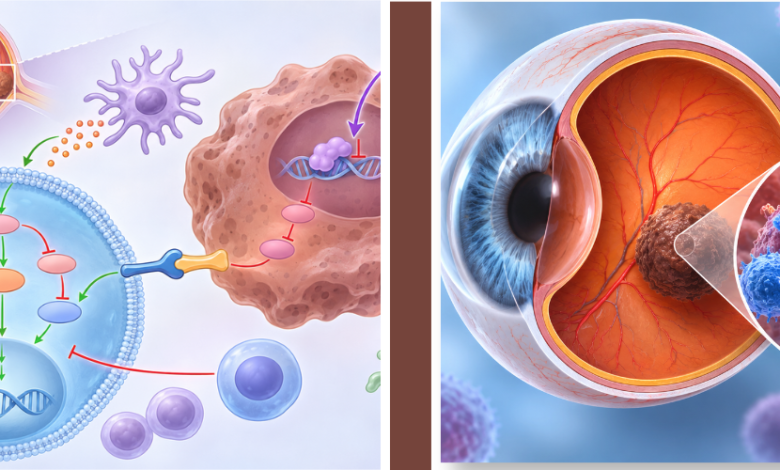
JQ1 PD-L1 uveal melanoma is an emerging area of cancer research examining how epigenetic drugs may influence tumor growth and immune responses in a rare form of eye cancer. Scientists are investigating JQ1, an experimental BET protein inhibitor, alongside the PD-1/PD-L1 immune pathway to understand possible approaches to overcoming treatment resistance.
Although laboratory findings have identified promising anticancer effects, JQ1 is not an approved treatment for uveal melanoma. Its relationship with PD-L1 remains complex, making further clinical research essential.
What Is JQ1 PD-L1 Uveal Melanoma?
The term combines three medical concepts: JQ1, PD-L1, and uveal melanoma. JQ1 is an experimental compound that blocks bromodomain and extraterminal (BET) proteins involved in regulating gene activity. PD-L1 is an immune-regulatory protein that some cancer cells use to reduce immune attacks.
Uveal melanoma develops from pigment-producing cells inside the eye. Researchers are exploring whether targeting gene regulation can suppress tumor growth or influence immune-related treatment resistance.
Understanding Uveal Melanoma
Uveal melanoma is the most common primary eye cancer in adults, although it remains relatively rare. It develops in the uveal tract, which includes the iris, ciliary body, and choroid.
Symptoms may include blurred vision, flashes of light, floating spots, or peripheral vision loss. Some patients experience no noticeable symptoms before diagnosis.
Unlike skin melanoma, uveal melanoma frequently involves mutations in GNAQ and GNA11. Changes involving BAP1 are also associated with a greater risk of metastasis.
The liver is the most common location for distant spread, making long-term medical monitoring important.
How Does JQ1 Work?
JQ1 inhibits BET proteins, particularly BRD4, which help control the expression of genes associated with cell growth and survival. By interrupting these processes, JQ1 may interfere with cancer-cell division.
Preclinical studies have demonstrated that JQ1 can reduce uveal melanoma cell proliferation and promote programmed cell death, known as apoptosis.
However, its effects depend on the biological characteristics of cancer cells. Results from laboratory experiments cannot establish whether the compound would be safe or effective in patients.
The Role of PD-L1
PD-L1, or programmed death-ligand 1, helps regulate immune activity. When it binds to the PD-1 receptor on T cells, it can reduce their ability to attack certain cancer cells.
Some tumors exploit this mechanism to escape immune surveillance. Immunotherapy drugs targeting PD-1 or PD-L1 attempt to restore the body’s anticancer immune response.
Unfortunately, conventional immune-checkpoint inhibitors generally produce lower response rates in uveal melanoma than in skin melanoma. Differences in tumor genetics and the immune environment contribute to this challenge.
How JQ1 Affects PD-L1
Researchers have investigated whether JQ1 changes PD-L1 expression through BET protein inhibition.
A 2022 study published in Melanoma Research compared JQ1 with entinostat, another experimental epigenetic therapy. Entinostat increased PD-L1 expression and certain antigen-presentation proteins in human uveal melanoma cells.
JQ1 did not produce comparable changes in the tested human uveal melanoma cell lines.
In a separate mouse melanoma model, JQ1 reduced PD-L1 expression. These findings demonstrate that its immune-related effects vary between experimental models.
The study also found that combining a related BET inhibitor with checkpoint immunotherapy worsened long-term outcomes in mice compared with immunotherapy alone.
Potential Benefits of JQ1
Laboratory research suggests several possible anticancer effects of JQ1.
One potential benefit is slower tumor growth, as BET inhibition can interfere with mechanisms responsible for cancer-cell division.
Researchers have also observed increased apoptosis and reduced cancer-cell migration in experimental uveal melanoma models.
A study published in Cellular Signalling in January 2025 identified an additional connection between JQ1 and ABCB5, a protein associated with cancer survival and drug resistance.
The researchers reported that JQ1 altered ABCB5-related autophagy and increased sensitivity to certain chemotherapy drugs in preclinical experiments.
These findings support further investigation, but they do not demonstrate improved survival or treatment outcomes in human patients.
JQ1 and Epigenetic Therapy
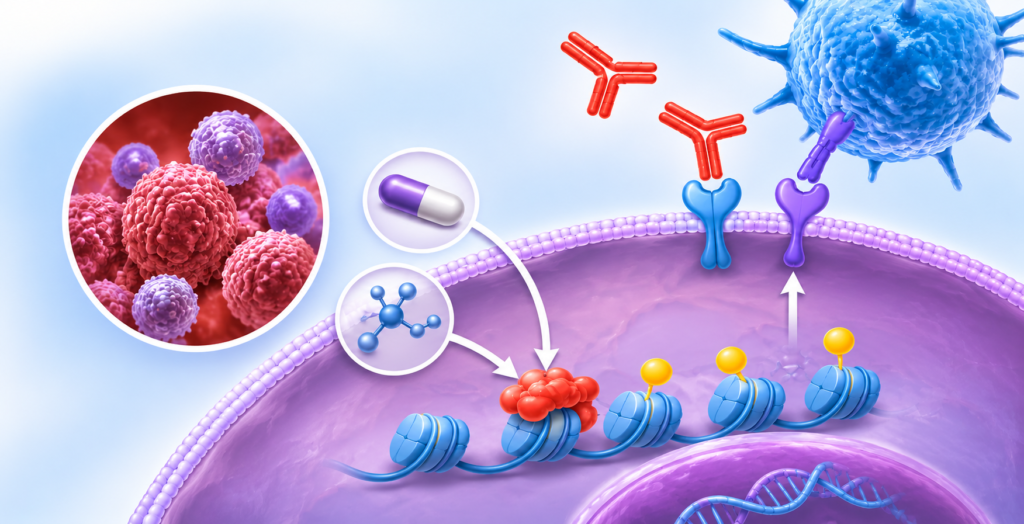
Epigenetic therapy aims to influence how genes function without directly changing their underlying DNA sequence.
BET proteins help interpret chemical signals involved in gene regulation. JQ1 interferes with these proteins, potentially disrupting pathways that support cancer development.
This approach differs from conventional chemotherapy because it targets mechanisms controlling cellular behavior rather than primarily attacking rapidly dividing cells.
Nevertheless, epigenetic treatments can affect healthy tissues and immune cells. Researchers must establish whether potential anticancer benefits outweigh these risks.
JQ1 and Immunotherapy Research
Combining epigenetic treatment with immunotherapy is an important research interest. However, different epigenetic drugs can produce substantially different effects.
The 2022 Melanoma Research study found that entinostat improved certain immune responses when combined with PD-1 inhibition in experimental models.
By contrast, BET inhibition did not improve checkpoint treatment in the same research program and impaired long-term outcomes in one mouse model.
These results highlight why JQ1 and entinostat should not be considered interchangeable. More evidence is required before recommending BET inhibitors alongside immunotherapy.
Current Treatment Options
Treatment for uveal melanoma depends on tumor size, location, disease progression, and overall patient health.
Localized tumors are commonly managed using plaque brachytherapy, proton-beam radiation, or surgery. Some advanced cases require removal of the affected eye.
For eligible patients with unresectable or metastatic disease, tebentafusp is an established treatment option. It is used in patients who test positive for HLA-A*02:01.
Other approaches may include liver-directed treatments, selected systemic therapies, and clinical trial participation.
Treatment decisions should involve specialists experienced in ocular oncology.
Challenges and Future Research
JQ1 research faces several challenges, including uncertain clinical effectiveness, potential toxicity, and the possibility of treatment resistance.
Scientists must also determine how BET inhibition influences immune cells alongside cancer cells.
Future studies may investigate more selective BET inhibitors, identify biomarkers predicting treatment response, and evaluate combinations with other therapies.
Understanding the relationship between BRD4, ABCB5, and immune signaling could help identify more effective treatment strategies.
Conclusion
JQ1 PD-L1 uveal melanoma research offers valuable insights into experimental approaches targeting cancer-related gene regulation. Laboratory findings suggest that JQ1 may suppress tumor growth, influence cellular survival mechanisms, and improve sensitivity to certain chemotherapy drugs.
However, its effects on PD-L1 vary, and available evidence does not establish that JQ1 improves immunotherapy outcomes in patients.
Continued research is essential before BET inhibitors can become established treatment options for uveal melanoma.
Research References
- Sah et al. (2022). Epigenetic therapy to enhance therapeutic effects of PD-1 inhibition in therapy-resistant melanoma. Melanoma Research. https://pmc.ncbi.nlm.nih.gov/articles/PMC9245557/
- The BET inhibitor JQ1 suppresses tumor survival by ABCB5-mediated autophagy in uveal melanoma. Cellular Signalling (2025). https://doi.org/10.1016/j.cellsig.2024.111483
- American Society of Clinical Oncology. Systemic Therapy for Melanoma: Guideline Update. https://doi.org/10.1200/JCO.23.01136
FAQs
What is JQ1 PD-L1 uveal melanoma?
It refers to research investigating JQ1, an experimental BET inhibitor, and PD-L1-related immune mechanisms in uveal melanoma.
Can JQ1 treat uveal melanoma?
JQ1 has demonstrated anticancer effects in preclinical research, but it is not approved for treating uveal melanoma.
Does JQ1 reduce PD-L1 expression?
JQ1 has reduced PD-L1 expression in certain experimental cancer models, but this effect was not observed in the tested human uveal melanoma cells in a 2022 study.
What are the potential benefits of JQ1?
Experimental findings include reduced cancer-cell growth, increased apoptosis, and improved sensitivity to selected chemotherapy drugs.
Is JQ1 safe for cancer patients?
Its clinical safety and effectiveness for uveal melanoma have not been established. Patients should not use JQ1 outside appropriately supervised research.
Must Read: Lauren Holly Measurements, Age, Height, Family & Career