
Every business depends on suppliers to keep its operations running smoothly. However, unexpected delays, rising material costs, and supplier failures can interrupt production and affect profitability. Supply risk management helps organizations identify these threats before they become serious problems.
By understanding potential risks and preparing practical solutions, businesses can protect their operations, maintain reliable deliveries, and build stronger supplier relationships.
What Is Supply Risk Management?
Supply risk management is the process of identifying, evaluating, and reducing risks that affect the availability, cost, quality, and delivery of goods or services. It involves monitoring suppliers, assessing potential disruptions, and developing plans to maintain business operations.
For example, a manufacturer relying on one supplier may experience production delays if that supplier closes unexpectedly. Having alternative suppliers reduces this risk.
Why Supply Risk Management Matters
Supply disruptions can increase operating costs, damage customer relationships, and interrupt essential business activities. Even a minor delivery problem can affect several departments when companies depend on tightly connected supply networks.
According to Deloitte, effective supply chain risk management requires supplier due diligence, accurate payment processes, performance monitoring, and coordination between business departments.
Common Types of Supply Risks
Businesses encounter different risks depending on their industry, suppliers, and geographic locations. Understanding these categories makes it easier to recognize vulnerabilities and prepare appropriate responses.
| Risk Type | Common Example |
|---|---|
| Supplier Risk | Supplier bankruptcy or production failure |
| Financial Risk | Unexpected material price increases |
| Operational Risk | Equipment breakdowns |
| Logistics Risk | Shipping delays or port closures |
| Geopolitical Risk | Trade restrictions and political conflicts |
| Environmental Risk | Flooding or severe weather |
| Cybersecurity Risk | Supplier data breaches or ransomware |
How to Implement Supply Risk Management
An effective supply risk management process generally involves five steps:
- Identify risks: Examine suppliers, materials, transportation, and external conditions.
- Assess risks: Evaluate their likelihood and potential business impact.
- Prioritize threats: Focus on risks affecting critical operations.
- Implement controls: Introduce alternative sourcing, monitoring, and contingency measures.
- Review performance: Update assessments and improve existing controls.
The ISO 31000 standard provides widely applicable principles and guidance for organizing risk management activities.
Benefits of Effective Supply Risk Management
A well-organized risk management approach improves business continuity by reducing exposure to unexpected supplier disruptions.
It also supports better cost control, more reliable product availability, stronger supplier relationships, and improved customer satisfaction.
Businesses gain greater confidence in procurement decisions when they understand their supply vulnerabilities and available alternatives.
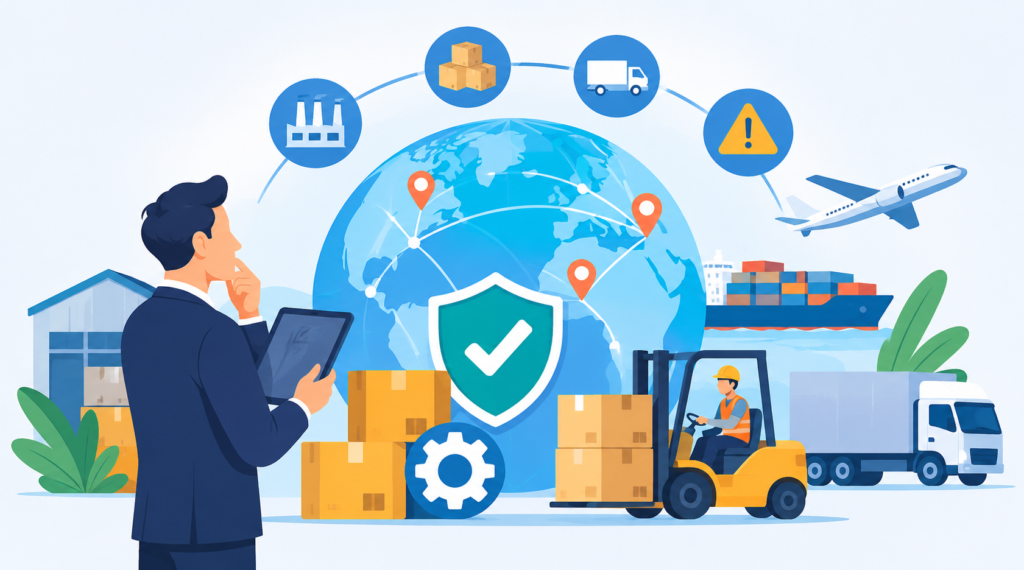
Technology in Supply Risk Management
Modern technology helps procurement teams analyze supplier information and monitor potential disruptions. Enterprise resource planning systems connect purchasing and inventory data, while analytics tools help identify unusual patterns.
Artificial intelligence can support forecasting and early warnings, although predictions still require human judgment.
The National Institute of Standards and Technology also provides guidance for assessing and managing cybersecurity risks involving technology suppliers.
Example of Supply Risk Management
Consider a furniture manufacturer purchasing wood from a single supplier. Unexpected flooding damages the supplier’s production facility, delaying deliveries and interrupting furniture manufacturing.
The company can reduce future exposure by qualifying additional suppliers, maintaining appropriate material reserves, and monitoring regional weather risks.
This example demonstrates how preparation can limit the consequences of supply disruptions.
Best Practices for Long-Term Success
Successful supply risk management requires consistent attention rather than occasional reviews. Businesses should maintain accurate supplier records, monitor performance indicators, and regularly test contingency arrangements.
Procurement, finance, logistics, and operations teams should also share relevant information.
Continuous improvement helps organizations adapt as supplier relationships, market conditions, and business requirements change.
Conclusion
Supply risk management helps businesses reduce uncertainty, protect operations, and maintain dependable supplier relationships. Although supply disruptions cannot always be prevented, their impact can be reduced through careful planning.
Supplier diversification, regular risk assessments, better visibility, and effective contingency plans give organizations a stronger foundation for long-term operational stability.
FAQs
What is the main purpose of supply risk management?
The main purpose of supply risk management is to identify potential supply disruptions, reduce operational risks, and ensure businesses receive essential materials and services without unnecessary delays.
What are the biggest challenges in supply risk management?
Common challenges include supplier failures, rising material costs, transportation delays, limited supply chain visibility, and unexpected market changes. These problems can affect business operations and profitability.
How can businesses improve supply risk management?
Businesses can improve supply risk management by diversifying suppliers, conducting regular risk assessments, monitoring supplier performance, and developing backup plans to handle unexpected disruptions.
What is the role of technology in supply risk management?
Technology helps businesses monitor supplier performance, track shipments, analyze supply chain data, and identify potential risks. Digital tools also support faster decision-making and better inventory planning.
What is the difference between supply risk management and supply chain risk management?
Supply risk management focuses mainly on supplier reliability, sourcing, and material availability. Supply chain risk management covers broader risks involving procurement, manufacturing, transportation, distribution, and customer delivery.
Must Read: Ecommerce Marketing: How It Works and Why It Matters