
Technology has become an essential part of everyday business operations. From managing customer information to protecting company networks, businesses depend on reliable IT systems. However, maintaining these systems can be expensive and complicated, particularly for smaller organizations.
A managed IT service provides professional technology support without requiring businesses to maintain a complete internal IT department. Through ongoing monitoring, maintenance, and cybersecurity assistance, managed IT services help organizations improve productivity, reduce technical disruptions, and manage their technology more effectively.
What Is a Managed IT Service?
A managed IT service involves outsourcing specific technology responsibilities to a third-party company known as a Managed Service Provider (MSP). These providers manage IT infrastructure, computer networks, software, security systems, and technical support through an ongoing service agreement.
For example, a small business might hire an MSP to maintain employee computers, install security updates, monitor network performance, and manage data backups.
How Does a Managed IT Service Work?
Managed IT services begin with an assessment of a company’s technology requirements. The provider examines existing systems, identifies potential problems, and recommends suitable services.
After establishing an agreement, the MSP monitors covered systems, performs maintenance, and responds to technical issues. Service Level Agreements (SLAs) typically define responsibilities, support availability, and response targets, helping both parties understand their obligations.
Types of Managed IT Services
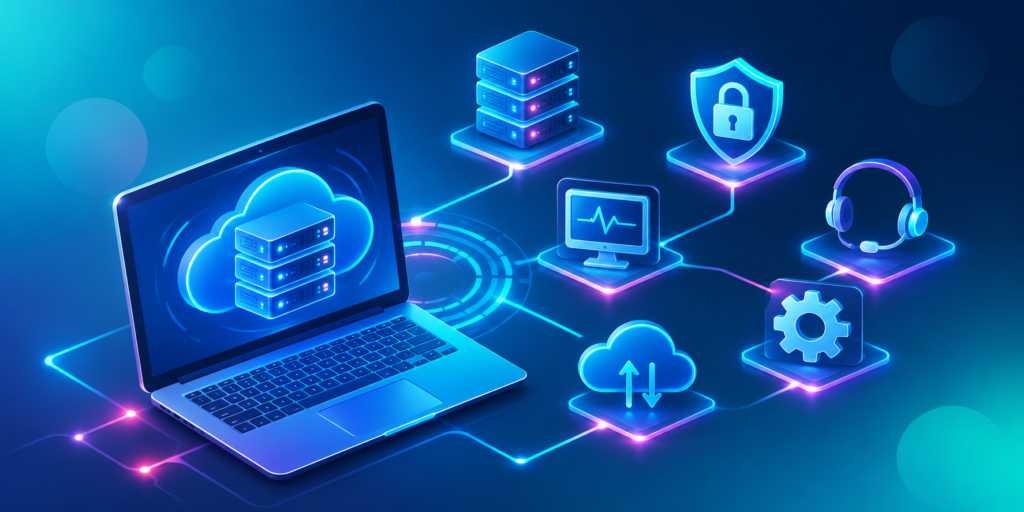
Managed IT services cover several important areas of business technology. The most common options include:
- Network Management: Monitoring internet connectivity, servers, routers, and business networks.
- Cybersecurity Services: Managing firewalls, security updates, threat monitoring, and endpoint protection.
- Cloud Management: Supporting cloud applications, storage, infrastructure, and migrations.
- Data Backup: Maintaining backups and supporting recovery after data loss.
- IT Help Desk: Providing technical assistance to employees experiencing software or hardware problems.
- Infrastructure Management: Maintaining servers, storage systems, and other essential technology.
Businesses can choose individual services or combine several options according to their requirements.
Benefits of Managed IT Service
One major benefit of a managed IT service is access to experienced professionals without hiring specialists for every technical responsibility. Providers can monitor systems, identify performance problems, and support regular maintenance.
Other advantages include predictable service expenses, improved security management, reduced downtime, and greater scalability. Outsourcing routine IT tasks also allows employees to concentrate on customers, business development, and daily operations.
Key Features of Managed IT Services
Reliable managed IT services generally include proactive monitoring, scheduled maintenance, software updates, technical support, and performance reporting.
Some providers also offer strategic IT consulting, disaster recovery planning, and continuous security monitoring. However, features differ between packages. Businesses should confirm whether remote assistance, on-site visits, after-hours support, and cybersecurity services are included before signing an agreement.
Managed IT Service vs. Traditional IT Support
Traditional IT support commonly follows a reactive approach, addressing technical problems after they occur. Managed IT services emphasize ongoing monitoring and preventive maintenance.
| Feature | Managed IT Service | Traditional IT Support |
|---|---|---|
| Approach | Proactive | Mostly reactive |
| Payment | Usually recurring | Often per incident |
| Monitoring | Ongoing | Limited or optional |
| Maintenance | Scheduled | Often problem-based |
| Planning | May include IT strategy | Usually focused on repairs |
Neither approach suits every organization. Businesses with ongoing technology requirements may benefit more from managed services.
How Much Does a Managed IT Service Cost?
Managed IT service pricing depends on company size, supported devices, service hours, security requirements, and infrastructure complexity.
Common pricing models include per-user fees, per-device charges, flat monthly subscriptions, and tiered packages.
Some providers charge separately for cloud subscriptions, equipment, on-site visits, and major projects. Comparing the complete service scope is more useful than choosing a provider based only on its advertised monthly fee.
Who Needs Managed IT Services?
Managed IT services are particularly useful for small businesses, growing companies, and organizations without dedicated technology departments.
Companies operating remote teams, multiple offices, or essential online systems may also benefit from professional IT management. Businesses with existing IT employees can choose co-managed services, allowing external specialists to support their internal teams without replacing them.
Challenges of Managed IT Services
Despite their advantages, managed IT services introduce certain challenges. Businesses may become dependent on external providers for important technical operations, while unclear contracts can create unexpected expenses.
Security also requires careful attention. Giving a provider access to company systems introduces third-party risks. Outsourcing IT management does not eliminate the customer’s responsibility for protecting business information, making clear security responsibilities essential.
How to Choose a Managed IT Service Provider
Choosing the right MSP requires more than comparing prices. Businesses should evaluate technical experience, customer references, security practices, and support availability.
A suitable provider should offer transparent service agreements, clear communication, documented response procedures, and appropriate backup arrangements.
Before signing, ask about data ownership, incident reporting, contract termination, and how systems will be transferred if the business changes providers.
Future of Managed IT Services
Managed IT services continue to evolve alongside cloud computing, automation, and cybersecurity technologies.
Providers increasingly use automated monitoring and AI-assisted tools to identify unusual activity and prioritize technical issues. Hybrid cloud management and stronger identity security are also important areas of development.
Nevertheless, experienced professionals remain essential for complicated troubleshooting, business planning, and critical security decisions.
Conclusion
A managed IT service helps businesses maintain reliable technology through professional monitoring, maintenance, security support, and technical assistance. It can reduce operational disruptions while giving organizations access to specialized expertise.
However, selecting the right provider requires careful consideration of costs, service quality, and security responsibilities. With an appropriate agreement, managed IT services can support efficient operations and sustainable business growth.
Sources
- Cloudian — Managed IT Services Guide
- IBM — Managed Cloud Services
- CISA — Risk Considerations for MSP Customers
Meta Description: Learn what managed IT service is, how it works, its benefits, types, costs, challenges, and how to choose the right provider for your business.
FAQs
What is a manarged IT service?
It is outsourced technology management provided by an MSP, covering agreed responsibilities such as monitoring, maintenance, and technical support.
What are the benefits of managed IT services?
They can improve system reliability, provide technical expertise, strengthen security management, and make routine IT expenses more predictable.
Are managed IT services expensive?
Costs vary depending on business size, infrastructure, service coverage, and security needs.
Can small businesses use managed IT services?
Yes. Small businesses can select packages that match their technology requirements and available budgets.
Do managed IT services include cybersecurity?
Many providers offer cybersecurity assistance, but specific protections must be confirmed in the service agreement.
Must Read: Jennifer Rodrigo: Meet Olivia Rodrigo’s Mother